


Oakwater Advisors · For Retirees/Pre-Retirees

For retirees and pre-retirees

You saved for decades. Let’s name your next three moves.

On our first call, by phone or Zoom, we’ll look at your savings, your income sources and your timeline, and name the three things worth doing first. They’re yours whether or not we work together.

Already have an advisor? Get a second look

Alex Lawrence, financial advisor
Alex LawrenceFinancial advisor for retirees and pre-retirees

Your two-minute check

6 questions

Is your income ready for a bad first five years?

Why Oakwater Advisors

We don’t just manage your wealth. We create a plan to use it.

Once you start living on your savings, it’s not just how your investments perform that matters. It’s when. A market drop in the first few years, while you’re withdrawing to live on, can do damage that later good years may not make up for. It’s called sequence of returns risk.

My promise: As a fiduciary, if you pay me to manage your money, I should keep earning it. I look for opportunities all year, not just at your annual review, and bring them to you first. When something falls outside my licenses, I’ll bring in the right CPA, attorney or specialist and work alongside them.

  • Series 7
  • Series 63
  • Series 66
  • Life & Health
Check my record on FINRA BrokerCheck (opens in a new tab)
Two retirees, same $1,000,000, same marketExample
With a Conservative bucketEverything invested
$0M$1M$2M6570758085 $1.02M $445K
Hypothetical illustration: both start with $1,000,000 at 65 and withdraw $70,000 at the start of each year, rising 1% a year. Invested money matches the S&P 500 Index’s annual total returns from 1973 to 1993 (1973 to 1999 for the age-92 figures). With a Conservative bucket, three years of withdrawals (about $212,000) are set aside at 65 earning a hypothetical 3% a year and used for the withdrawal in each year after a market loss until they run out; the bucket isn’t refilled in this example. Different time periods would produce different results; when markets rise early in retirement, keeping everything invested can end with more. Does not reflect fees, expenses or taxes. You can’t invest directly in an index. Past performance doesn’t guarantee future results.
$445Kleft at 86 with everything invested, selling through the down years
$1.02Mleft at 86 with a Conservative bucket paying the bills after down years
Keep going to 1999

The late-’90s bull market arrives, and the gap widens.

At 92, with a Conservative bucket$2.31M
At 92, everything invested$311K
  1. The market drops early. Your bills don’t.
  2. You sell more to cover the same paycheck, locking in the loss.
  3. Fewer shares are left to recover when the market does.

What we do about it

Don’t sell in a down year.

We keep three to five years of your income gap in a Conservative bucket, kept apart from your growth investments. When markets fall, your paycheck can come from there, so your growth investments may not need to be sold low and can have time to recover. We refill it on a rule we set together.

Already working with an advisor?

Get a second look.

A second look doesn’t mean switching. On one call, I’ll look at how your income plan would hold up to a bad first few years, the order you’re drawing from your accounts and your Social Security timing, and tell you what I’d change, if anything.

Other risks we plan for:

01

Health care surprises

Coverage before 65, Medicare choices and long-term care can drain savings fast.

02

Taxes on the way out

Pre-tax accounts are taxed as you withdraw, and the wrong order can cost you for decades.

03

Social Security on autopilot

Claiming early by default can mean a permanently smaller check.

04

Living longer than the plan

Your money may need to last 30 years or more.

The fix isn’t more products. It’s one plan, in the right order, with someone keeping every piece pointed the same direction.

Who we help

Whether retirement is close or already here.

Retiring within 10 years

Getting close, and want to know you’re ready?

The decisions you make in the last decade before retirement shape the next thirty years.

  • Catch-up contributions, including the new Roth rule for high earners
  • A Social Security claiming age chosen, not defaulted
  • Health coverage lined up until Medicare at 65
  • A Conservative bucket built before you need it
  • Roth conversions planned before required distributions
Book a call
Already retired

Retired, and want your income to last?

You have the savings. Now the job is turning them into a paycheck you can count on, without selling low or overpaying in taxes.

  • A monthly retirement paycheck to your Reservoir
  • A personal pension for income you can’t outlive
  • Buckets refilled on a rule, not a hunch
  • Withdrawals in an order designed to keep more after taxes
  • Long-term care and estate plans kept current
Book a call

The Oakwater approach

Three moves, always in the same order.

We use a 4 Bucket Strategy: Bucket 1 protects against health care costs, Bucket 2 harnesses reliable income, and Buckets 3 and 4 deploy the rest, part kept secure and part invested for growth.

Start here

Protect against health care costs

Bucket 1, Protection: a bridge to Medicare, a long-term care plan, right-sized insurance and a current estate plan, to help keep one health event from draining the other buckets.

Protection bucket check-up Example
  • Health coverage to 65Marketplace plan until Medicare startsCovered
  • Medicare enrollmentWindow opens three months before turning 65On the calendar
  • Long-term careNo plan to pay for care yetGap found
  • Life & umbrellaSized to what you own nowCovered
  • Will, trust & directivesUpdating with an estate attorneyIn progress

Then

Harness reliable income

Bucket 2, Income: Social Security, pensions and a personal pension cover your core spending, so the essentials get paid whatever the markets do.

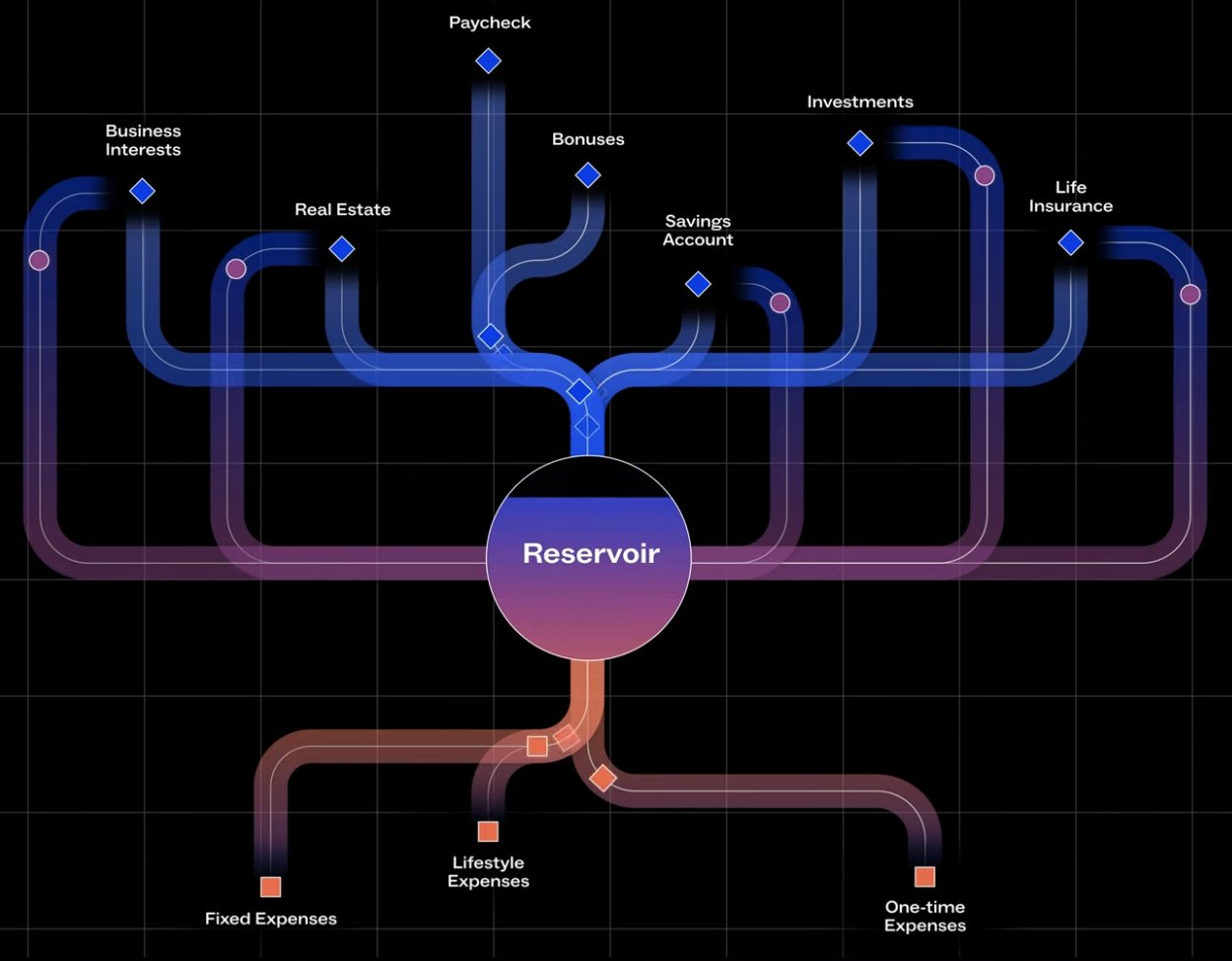
Diagram of a Reservoir: paycheck, bonuses, savings, investments, real estate, business interests and life insurance all flow into one Reservoir, which then flows out to fixed, lifestyle and one-time expenses.
The Reservoir, in retirement. Social Security, pensions and a monthly retirement paycheck from your buckets land in one place first, then flow out to your spending account(s): to fixed bills, lifestyle and one-time costs. This automates retirement spending.

Finally

Deploy it for growth

Bucket 3, Conservative: three to five years of the income gap, kept out of market swings, so a down market is less likely to force you to sell at a loss to pay bills. Bucket 4, Growth: long-term money invested to outpace inflation and refill the Conservative bucket after good years, with withdrawals and Roth conversions planned for lower lifetime taxes.

Buckets on the calendar Example
  1. 2027Conservative bucket: 4 years of the gap80% done
  2. 2028Roth conversions before distributions45% done
  3. 2030Personal pension in place30% done
  4. 2032Social Security claimed at 6720% done

Your advisor

Hi, I’m Alex. Roots that hold. Money that moves.

I’m the advisor behind Oakwater Advisors. The two things I love most are the outdoors and financial planning, so I built something that represents both.

An oak grows slowly and is built for storms it hasn’t seen yet. Water does the opposite: it keeps moving and finds a way through. A good plan needs both: foundations that barely change, and money inside them that keeps working.

Alex Lawrence, smiling, in a light plaid jacket and blue shirt
Alex LawrenceFinancial advisor

Resources

Start on your own. We’re here when you want a second set of eyes.

A retirement guide, a cash-flow guide and a calculator, built around the same three moves we use in every plan.

PDF guide · 8 pages The Retirement Playbook Four buckets. Income that lasts.

Turn your savings into income that lasts

The 4 Bucket Strategy, organized into Protect, Harness and Deploy, with a countdown from 10 years out and a checklist and scorecard at the end.

  • Four retirement concerns, four buckets
  • Social Security, Medicare and a personal pension
  • Taxes, Roth conversions and withdrawal order
  • A 15-question checklist and scorecard
PDF guide · 6 pages Reservoir Savings Save by default. Spend by decision.

A simple cash-flow system that raises your savings rate

Why your savings rate matters more than your returns, and how to set up a Reservoir in five steps.

  • What an optimal saver looks like
  • How money flows in, out and back to work
  • A one-page cash-flow map
Calculator Reservoir Savings Calculator Same paycheck. A very different result.

See what slowing your spending growth could add up to

Enter your income, what you save and your time frame. Compare your current path with a Reservoir in under a minute.

  • Your savings rate today vs. over your lifetime
  • Dollars saved, or at a hypothetical 7% return
  • Year-by-year breakdown

Questions

Good questions to ask before you start.

Don’t see yours? Ask it on an intro call.

Is it too late to plan if I’m already retired?

No. Social Security, withdrawal order, taxes and how your buckets are set up can all still be improved, and small changes add up over a long retirement.

I already have an advisor. Can you still help?

Yes. A second look doesn’t mean switching. I’ll review how your income plan holds up to a bad first few years, your withdrawal order and your Social Security timing, and tell you what I’d change, if anything. What you do with it is up to you.

What is a personal pension?

It’s our name for an income annuity: part of your savings turned into lifetime income you can’t outlive, much like a pension from an employer. Guarantees depend on the issuing insurance company’s ability to pay, and the money is less flexible once committed.

When should I claim Social Security?

It depends on your health, your other income and your spouse. You can claim between 62 and 70, and each year you wait past full retirement age raises your benefit 8%. We’ll compare the options with you.

Do you only work with retirees/pre-retirees?

No. We also specialize in physician assistants and owners of closely held businesses. Planning for PAs · Planning for business owners.

I already have a CPA. Why would I need a financial planner?

Your CPA mostly looks back at the year that just happened. Planning looks ahead: protection, cash flow, investments and retirement, in order. We work alongside your CPA and attorney so everyone’s advice points the same direction.

How do you get paid?

Financial planning is fee-based, and the fee is quoted up front, in writing, before any work begins. If we also manage investments or help with insurance, we’ll explain exactly how we’re paid for each. OneAmerica Securities’ Form ADV Part 2 and Form CRS have the details.

What happens on the intro call?

It’s a conversation by phone or Zoom. We talk about where you are and what’s on your mind, and you leave knowing whether working together makes sense. No prep needed.

Get started

Start with a conversation.

Pick a time for a call. We’ll talk about where you are and what you’re working toward.

  • Protect
  • Harness
  • Deploy

Book an intro call

Pick a time that works for you. By phone or Zoom, no prep needed.

  • By phone or Zoom. Your choice when you book.
  • No cost, no pressure. We'll talk about where you are and whether planning makes sense.
  • Pick any open time. Your calendar invite arrives right away.
See open times

Opens Alex's scheduling page in a new tab.

Your guide

Get the guide

Tell me where to send it, and I’ll email it to you personally.

We use your information only to follow up. We never sell it.